
How to read a cross stitch chart
A cross stitch chart is a map: each square on it matches one square of fabric. Here's what it's made of.
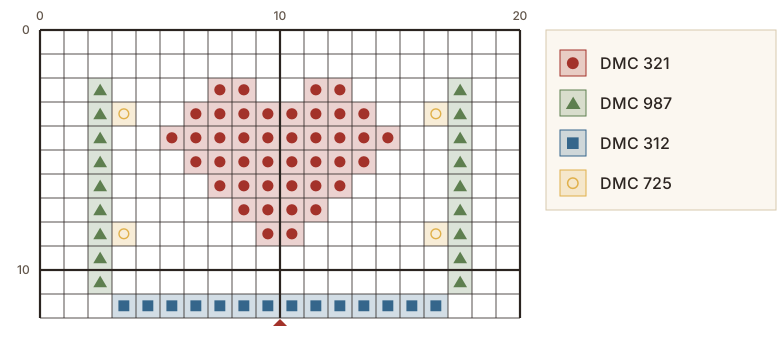
The grid
The chart is drawn on a grid. One square of the grid is one cross on the fabric. Every 10 squares the grid line is heavier, which makes counting easier. Square numbers — 10, 20, 30 and so on — are often printed along the edges.
Symbols and the key
The squares hold symbols or coloured blocks. Each symbol is a thread colour. What it stands for is in the chart's key (legend) — a table next to the grid. The key usually shows:
- the symbol and a colour swatch;
- the thread brand and code, for example DMC 310;
- the colour name;
- the number of strands for crosses and for backstitch;
- sometimes how many crosses of that colour there are or how many skeins you need.
An empty square means the fabric stays unstitched there.
The centre
There are usually arrows or triangles in the middle of each side of the grid. Lines drawn from them cross at the centre of the chart. Starting from the centre puts the design in the middle of the fabric.
Charts over several pages
Large charts are split into pages. The margin of each page usually shows which part of the design it is. Neighbouring pages often repeat a few rows along the edge — an overlap that helps you keep your place. Stitch repeated rows only once.
Fractional stitches
Besides full crosses, a chart may have:
- half stitches — a single diagonal stitch; usually half a square or a diagonal line on the chart;
- quarter stitches — from a corner of the square to its centre; a symbol in one corner of the square;
- three-quarter stitches — a half and a quarter together, used for smooth outlines.
Designers usually explain how fractional stitches are marked in the key or on a separate page.
Backstitch
Backstitch is a line of stitches worked along outlines. On the chart it shows as solid or coloured lines over the squares. It's usually stitched last, after the crosses, often with one strand. Its colours are listed in a separate part of the key.
Colour on screen and in real life
The colour of a square on the chart is approximate. Go by the thread code: the shade on a screen or printout can differ from the real thread.
Marking what you've stitched is easy with a pencil or an app. Crossette can highlight one colour and show how many crosses of each thread are left; the app is in development — see the home page.